Financing Available



Ductless
Cooling
Ductless Cooling For Your Home
Since 1999, our team of experts at Argus Air Systems has been providing quality and reliable services to ensure the comfort of our customers. With ample experience on ductless cooling systems, we can proudly say that we are one of the leading HVAC companies in Fairfield County.

Call Us 24/7

Licensed & Insured

Emergency Services
Contact Us

Ductless
What Is Ductless Cooling?
Air conditioners work by drawing heat energy out of the house, transferring it outdoors and subsequently replacing the air inside your home with cooler air. The ductwork is the part of the system that allows cool air to travel inside your home.
In a split system, the compressor condenses and circulates the refrigerant through the outdoor unit, changing it from gas to liquid. This liquid is then forced through the indoor evaporator or cooling compartment. An indoor unit fan circulates the inside air to pass across the evaporator fins. Thereafter, the evaporator’s metal fins exchange the thermal energy with the air around it. There, the refrigerant turns from liquid into vapor, removing any heat from the surrounding air. As the heat is removed from the air, the air is cooled and blown back into the house.
In a split system, the compressor condenses and circulates the refrigerant through the outdoor unit, changing it from gas to liquid. This liquid is then forced through the indoor evaporator or cooling compartment. An indoor unit fan circulates the inside air to pass across the evaporator fins. Thereafter, the evaporator’s metal fins exchange the thermal energy with the air around it. There, the refrigerant turns from liquid into vapor, removing any heat from the surrounding air. As the heat is removed from the air, the air is cooled and blown back into the house.
From that point, the condenser or outdoor unit then turns the refrigerant vapor back into a liquid, removing any heat. By the time the fluid leaves the evaporator again, it is a cool, low-pressure gas, eventually returning to the condenser to begin its trip all over again. This process repeats itself until your home reaches the desired cooling temperature, as programmed and sensed by your thermostat setting.
Many air conditioning systems can make your home cooler, but few can do the job as efficiently and professionally as Argus Air Systems Inc. can.
Choosing a new cooling system can be confusing. Explained below are some important HVAC terms that may help you better understand our process.
Many air conditioning systems can make your home cooler, but few can do the job as efficiently and professionally as Argus Air Systems Inc. can.
Choosing a new cooling system can be confusing. Explained below are some important HVAC terms that may help you better understand our process.
Contact Our Ductless Cooling Professionals For A Quote Today!

The Difference
EER Vs. SEER
Air Conditioners have a “SEER” (Seasonal Energy Efficiency Rating) or “EER” (Energy Efficiency Ration) – the higher the number, the more efficient the system. Our energy-efficient models start at a 13 SEER rating and our best achieves 20 SEER.

EER – Is The Cost of Operation During A Steady state Period of Operation.
80° dry bulb, 67° wet bulb = indoor air, 95° dry bulb, outdoor air
Energy
Efficiency
Ratio

SEER – Is The Average Cost of Operation During The Entire Cooling Season.
80° dry bulb, 67° wet bulb = indoor air, 82° dry bulb, outdoor air
Seasonal
Energy
Efficiency
Ratio
Though SEER ratings are established in a laboratory, the real conditions determine how your equipment will perform. Many things affect how cooling equipment meets the anticipated performance level:
Airflow
Without proper airflow, the desired temperature change across the evaporator will not occur, hence not cooling your home properly.
Charge
Improper refrigerant charge can greatly affect the performance of your air conditioner.
Tight Ducts
Duct leakage can greatly reduce the performance of your air conditioner. Make sure your ducts don’t leak.
Size
Equipment that is too large will hurt the performance of the unit. If it is sized too small, the equipment will not satisfy your cooling needs.
Ductless Cooling
Ductless Cooling System Maintenance Tips
Are you looking to install a new system or replace the old noisy clunker in the backyard? Give us a call and one of our friendly experts will happily answer all your questions!
A Proud Partner
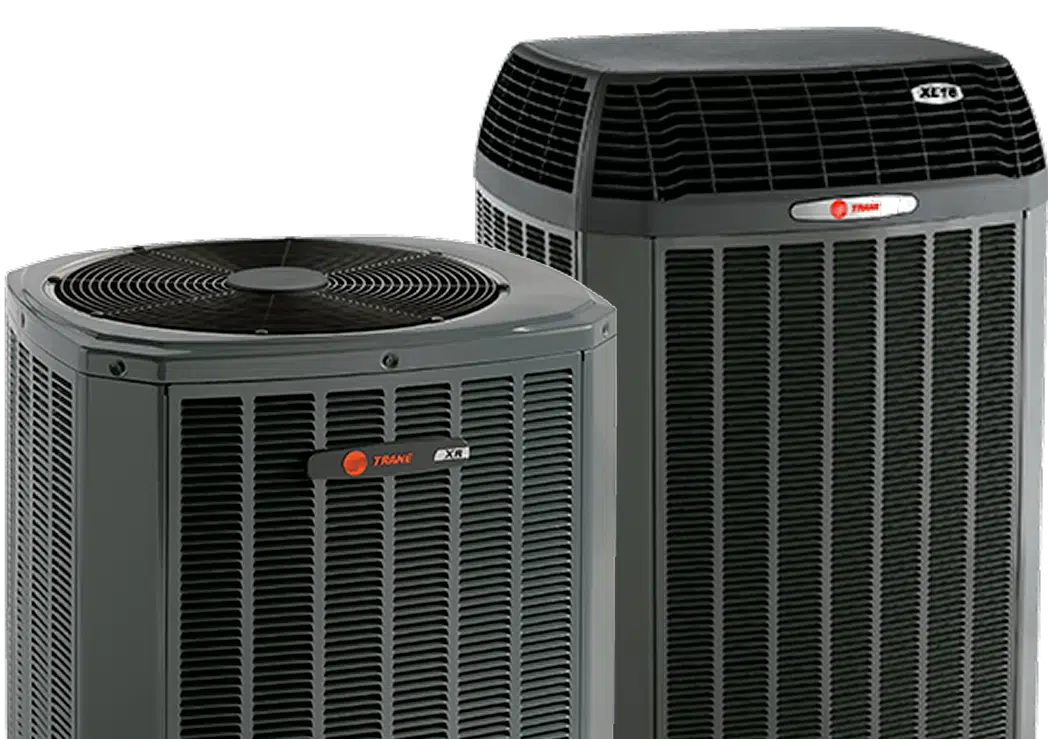
Trane Products
We are a proud partner of Trane. Click the button below to view products.